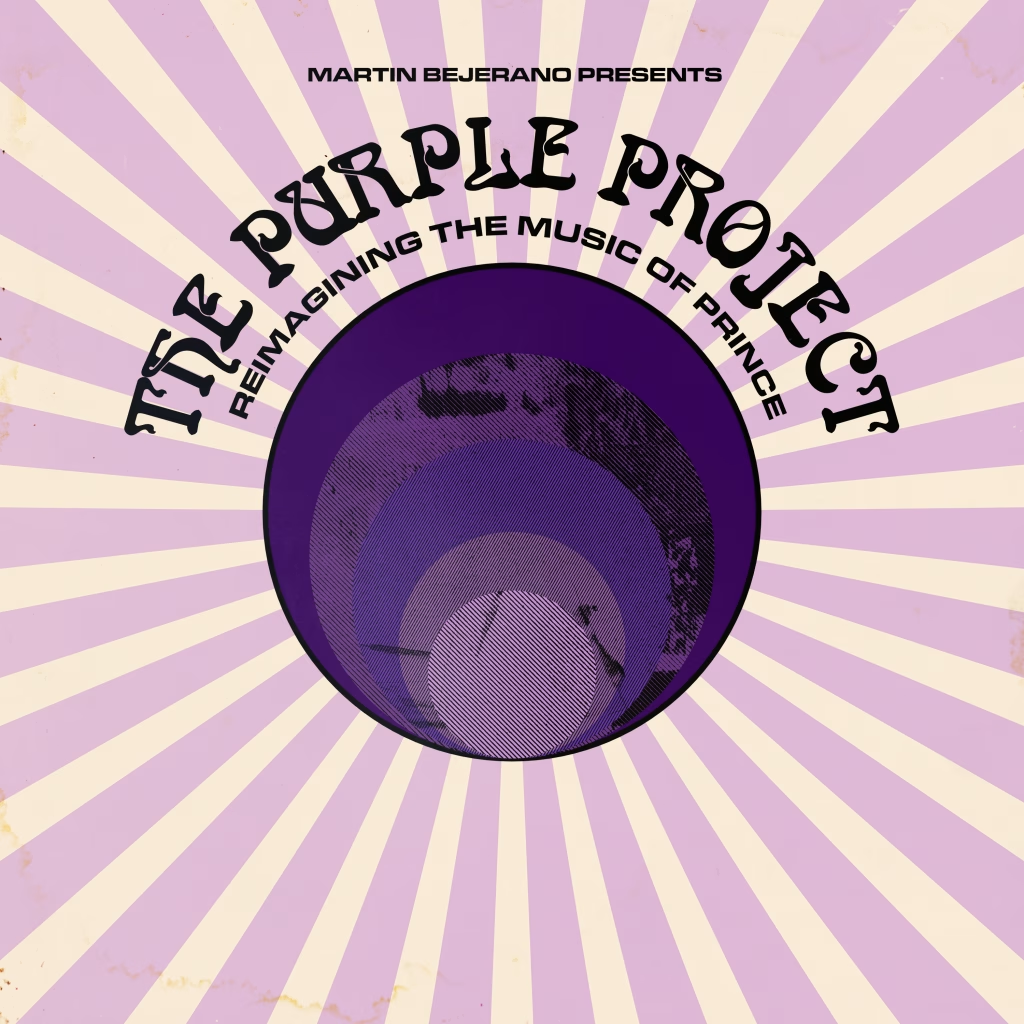
Martin Bejerano The Purple Project

Reimagining the Music of Prince (Figgland Records, 2025)
Overview
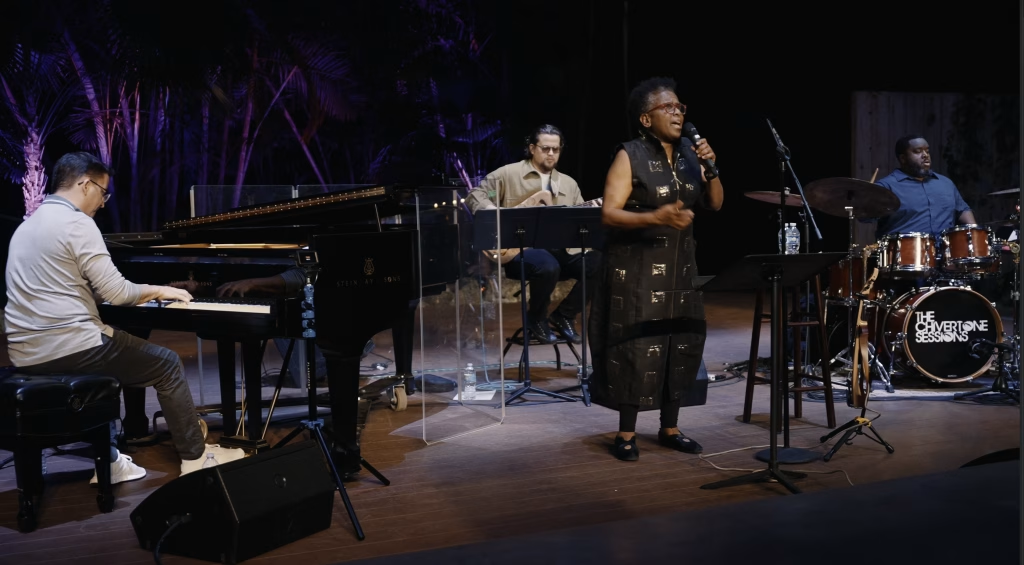
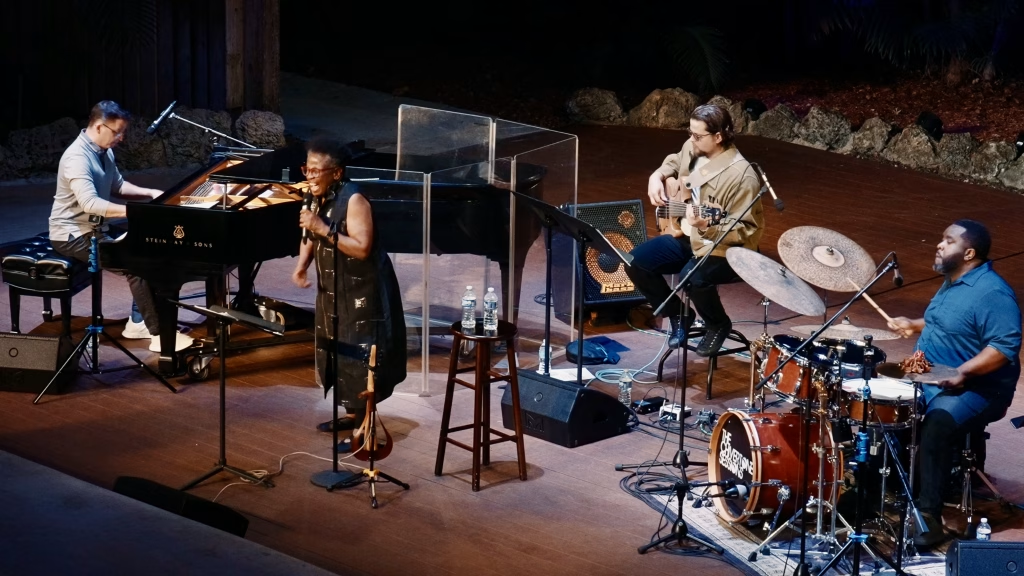
It takes a rare kind of musical courage to reinterpret the work of Prince — an artist whose legacy thrives on reinvention. Latin GRAMMY–nominated pianist, composer, and educator Martin Bejerano embraces that challenge with The Purple Project, a bold and imaginative reworking of ten songs from Prince’s golden era. Joined by vocalist Nicole Yarling, bassist Kurt Hengstebeck, and drummer David Chiverton, Bejerano builds a concept that deliberately avoids two elements inseparable from the Prince sound — guitar and a male lead voice. In their absence, he finds new textures and rhythmic pathways, replacing guitar lines with layered keyboard voicings and reconstructing familiar melodies through harmonic and rhythmic innovation.
Concept & Sound
The repertoire draws from four albums between 1984 and 1987 — Purple Rain, Around the World in a Day, Parade, and Sign O’ the Times — arguably Prince’s most fertile creative period. Bejerano’s approach doesn’t mimic or modernize; it reframes. Latin rhythmic inflections, odd meters, and subtle reharmonizations create a hybrid language where gospel, funk, Afro-Cuban, and jazz idioms intertwine. Yarling’s vocals bring emotional clarity and interpretive depth without attempting imitation — her phrasing moves fluidly between soulful grit and delicate restraint, highlighting the harmonic freedom of Bejerano’s arrangements.



Performance Highlights
The album opens with “Kiss,” one of Prince’s greatest hits from Parade. From the start, it reveals what the project is about to deliver — Latin-infused piano riffs, a tightly interlocked rhythm section, and a fearless sense of reinterpretation. Driven by a brisk, dance-like groove and marked by abstract harmonic shifts, Bejerano’s arrangement transforms one of Prince’s funkiest tunes into a forward-leaning pop-fusion piece energized by collective precision and flair.
Among the album’s standouts, “Raspberry Beret” shines for its inventive Afro-Cuban rhythmic treatment and subtle reharmonization of the verses. The Latin pulse gives the tune new lift while Bejerano’s harmonic turns feel fluid and organic, opening fresh spaces for Yarling’s phrasing and Chiverton’s crisp rhythmic accents.
The gospel-infused “The Beautiful Ones” is an emotional centerpiece — Yarling delivers a deeply expressive vocal performance supported by harmonies that unfold with a natural sense of tension and release. The trio’s brush-textured groove adds intimacy, and Bejerano’s extended solo builds with narrative clarity, evolving into an inspired exchange with Hengstebeck’s melodic electric-bass solo.
“Life Can Be So Nice” captures the album’s spirit of joyful exploration. It begins with an almost Keith Jarrett-like piano introduction over Yarling’s vocalizations, creating a luminous atmosphere that amplifies the song’s lyrical optimism. The rhythm section plays with tight precision and drive, and the inclusion of layered strings broadens the texture. Bejerano’s solo burns with rhythmic fire, punctuated by Chiverton’s dynamic fills, and the piece concludes with a high-energy coda lifted by lead-synth lines.
“Starfish and Coffee,” one of Prince’s most playful tunes, retains the charm of the original piano part while introducing a newly imagined bass line and a rich reharmonized chorus. The arrangement balances lightness and sophistication, with the strings once again adding warmth and momentum.
Interplay & Improvisation
Throughout the album, Bejerano’s trio functions as a single rhythmic organism. Hengstebeck’s electric bass lines often act as countermelodies, particularly in “When Doves Cry” and “Starfish and Coffee,” where Bejerano subverts Prince’s famously bass-less originals by foregrounding groove and low-end propulsion. Chiverton’s drumming navigates metric modulations and layered polyrhythms with precision and exuberance, while Yarling’s voice enriches the arrangements through expressive vocalises and delicate embellishments that intertwine with instrumental lines and hooks. Her interpretive choices give each piece a fresh contour, blurring the line between lead and accompaniment. The result feels less like a cover project and more like a collective act of re-composition.
Reharmonization & Emotional Arc
Bejerano’s harmonic imagination shines in “Under the Cherry Moon,” whose Bolero groove and lush chordal color give the song cinematic breadth. Yarling’s delivery carries a wistful, conversational quality, and her brief vocal scat before the final verse adds a spontaneous lift — a moment of free play that connects the track’s introspection to the album’s improvisational core.
The album also doesn’t miss “Purple Rain,” Prince’s most iconic song from the album and film of the same name. Here, it’s reimagined in a 6/4 rhythm, with carefully placed reharmonizations that steer the song away from the predictability of a standard cover, while preserving the emotional intensity and communal spirit of the original anthem.
“Tamborine,” which alternates between 7/4 and 4/4, morphs funk into Latin fusion, and the closing track, “Sometimes It Snows in April,” offers a striking emotional resolution — a near-faithful voice-and-piano rendering that erupts into a cathartic full-band coda, channeling the grief and transcendence embedded in the lyrics.
Final Impression
The Purple Project is not a tribute in the nostalgic sense, but a genuine act of creative dialogue with Prince’s artistry. Bejerano and his ensemble succeed in translating the restless invention and genre fluidity that defined Prince’s work into a contemporary jazz vocabulary rich with rhythmic sophistication and harmonic nuance. It’s a project that honors the source material by refusing to imitate it — a vivid testament to the enduring flexibility of Prince’s music and to Bejerano’s own imaginative voice as an arranger and improviser.