

The Bad Plus: A Collective Sound Built to Last

The Zig Zag Jazz Festival, Berlin – July 23, 2026
It is perhaps strange that in jazz, where teamwork and group interplay are so central, truly collective bands remain relatively rare. Jazz history is full of groups remembered through their individual stars, while the identity of the band itself often becomes secondary. The Bad Plus belongs to a different tradition. For more than 25 years, the group has developed a sound in which individuality serves the music rather than the other way around.
Founded by bassist Reid Anderson and drummer David King, The Bad Plus released its first album in 2000 and became known for its unusual approach to the piano trio format, as well as its adventurous arrangements of songs from outside jazz. After pianist Ethan Iverson left in 2017, Orrin Evans joined the group, before the trio expanded into a quartet in 2021 with the addition of guitarist Ben Monder and saxophonist and clarinetist Chris Speed.
This year, Anderson and King announced that they would bring their chapter of The Bad Plus to a close at the end of 2026. Their Berlin appearance at the sold-out Gasometer Hall was therefore one of the band’s final European concerts and its last in Berlin. Yet, despite the farewell context, the evening did not feel nostalgic. Instead, it offered a convincing reminder of what has made The Bad Plus such a distinctive collective for so long.


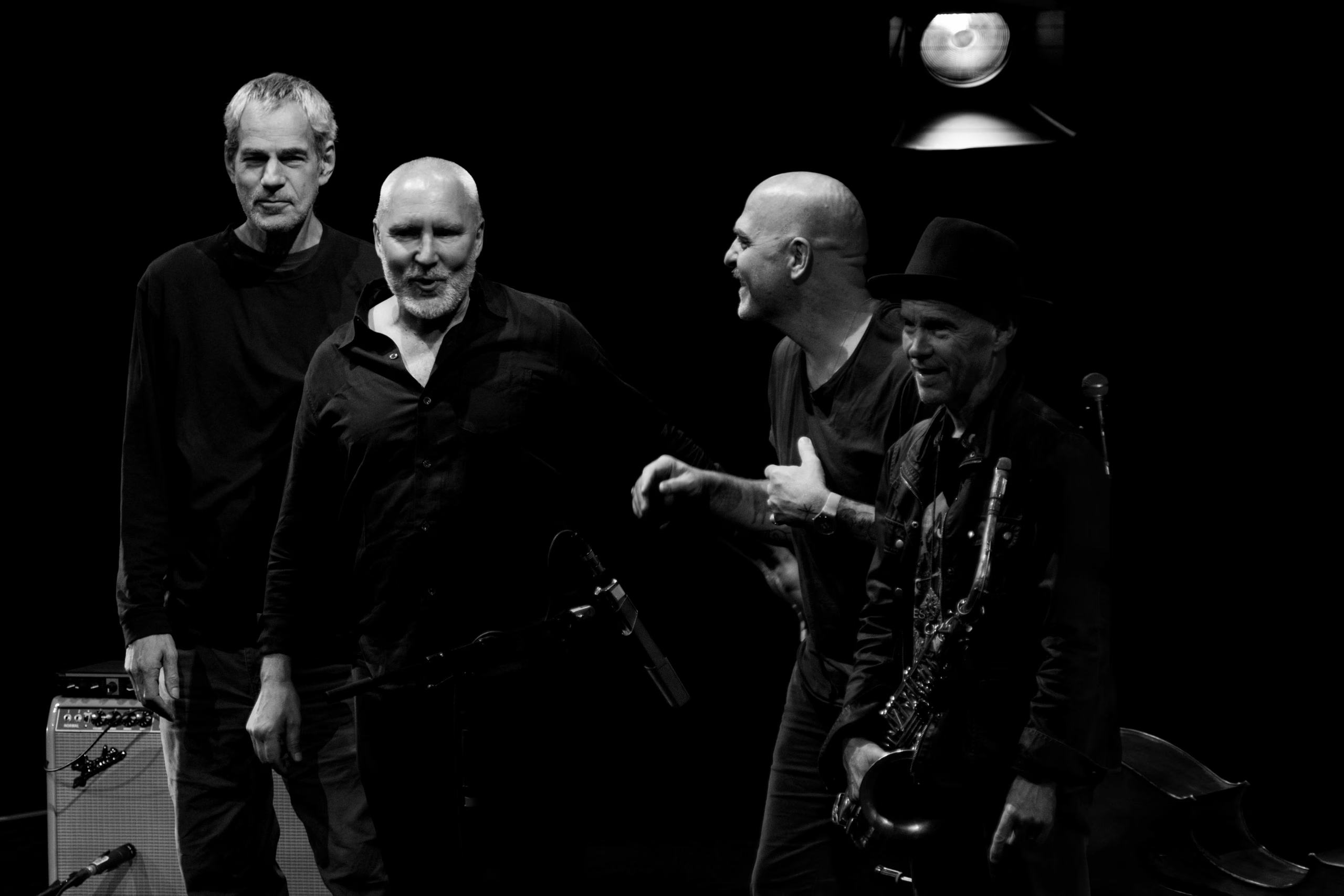


A rhythm section built on decades of trust
The band opened with three compositions from Complex Emotions, their latest album and, in its current form, their last. From the opening notes of Anderson’s Casa Ben, the chemistry between Anderson and King was immediately apparent.
Their chemistry was apparent not only in the music but also in the playful way they presented the band. After introducing each member, Anderson and King followed with a brief improvised musical phrase, turning the introductions into a kind of spontaneous jingle. It was a small moment, but it captured the ease and familiarity between them — the kind of interaction that comes naturally after decades of playing together. Their bass and drums created a firm rhythmic foundation, but never one that felt static. King could push the music forward while Anderson’s bass remained equally strong and flexible, creating space for Speed’s clarinet and Monder’s guitar, which moved between sustained clean tones and distorted textures. The result was a sound that felt carefully constructed but never overly controlled.
The Bad Plus has long been interested in experimenting with beats, grooves and unusual time signatures rather than treating jazz tradition as a fixed vocabulary. That approach became even more apparent in the two Anderson compositions that followed.
French Horns was driven by a kind of four-on-the-floor pulse and a memorable, almost singable theme. Carrier, by contrast, moved through a broken-beat framework. Yet the contrast between the pieces did not disrupt the group’s identity. The band’s collective sound remained intact.
Speed and Monder both took extended solos, but neither felt detached from the compositions. Their improvisations seemed to grow directly out of the material and return naturally to the group texture. Monder was particularly effective in layering chords and sustained sounds, filling the sonic space while still leaving room for Anderson and King to shape the rhythmic architecture underneath.
From Coltrane to the band’s own vocabulary
The Bad Plus became widely known for its inventive interpretations of pop and rock songs, but in Berlin the group played only one composition it had not written itself: John Coltrane’s Your Lady.
The choice felt particularly appropriate in a year marking the centenary of Coltrane’s birth. Yet the band did not approach the piece as a historical reference. They made it part of their own musical language, allowing Coltrane’s composition to sit naturally alongside their original material.
The transition from Carrier was especially effective. Monder introduced the piece with a beautiful, floating guitar texture before the music settled into a three-quarter waltz. During Speed’s solo, Monder dropped out completely, leaving the saxophonist to play for a while with Anderson and King alone.
That moment captured something essential about The Bad Plus. The musicians do not need to constantly demonstrate their individual abilities. They understand when to add something and, equally importantly, when to disappear. The space created by Monder’s absence became part of the arrangement, while Anderson and King continued to lock into each other with the kind of rhythmic understanding that can only come from decades of playing together.
The quiet side of the band
The concert also revealed that the group’s strength is not limited to rhythmic complexity and heavy grooves.
On Anderson’s ballad Grid/Ocean, King created the atmosphere with a delicate mallet introduction before the quartet gradually developed the piece around it. The change in dynamics showed another side of the band’s collective vocabulary. After the density and rhythmic drive of the earlier pieces, the music became spacious and restrained without losing its identity.
With the exception of Coltrane’s Your Lady, the Berlin programme was built around compositions by Anderson and King. This placed their work as composers more clearly in focus, while also connecting the new material with pieces from earlier stages of the band’s history.
Later in the set came some of those older compositions, including King’s jokingly introduced “hit song,” Anthem for the Earnest, from the 2005 album Suspicious Activity? The piece brought a more overtly rocking energy to the concert.
Anderson then took a solo introduction on bass before settling into the strong vamp of his composition Giant. These moments made clear that, while The Bad Plus has always been defined by its collective identity, that does not mean its individual musicians disappear. Instead, their personalities become most effective when placed within the larger architecture of the group.
A farewell without nostalgia
The regular set continued with Tyrone’s Flamingo, another recent composition, before the band closed with You Won’t See Me Before I Come Back. In the context of the evening, the title inevitably carried extra weight.
Anderson joked that the band might begin its reunion tour on January 2, 2027, only a few days after their scheduled final concert in their hometown of Minneapolis on December 28. The audience’s reaction suggested that the idea of a reunion would be more than welcome.
After more than an hour of music, the response was strong enough to bring the quartet back for an encore. They chose King’s Dandy, a gentle ballad that gradually calmed the energy of the evening and provided an appropriately understated goodbye.
Yet the final concert by The Bad Plus in Berlin did not really feel like a farewell. There was little sense of looking backwards. Instead, the performance felt like the work of a band that continues to evolve, both stylistically and musically, through collective interaction.
That may ultimately be one of The Bad Plus’s greatest achievements. To work together for almost three decades, to create new music, record it, tour it and still resist the temptation to settle into a formula is no small accomplishment. Their history shows that a band can have strong individual voices without allowing those voices to overpower the collective.
The Bad Plus may be closing one chapter at the end of 2026. But after hearing them in Berlin, it is difficult not to feel that the music itself still has unfinished business. Perhaps Anderson’s joke about a 2027 reunion was not such a joke after all.
Comments are closed.