

Melissa Aldana brings Cuban filin and lyrical jazz to Ljubljana

67. JAZZ FESTIVAL LJUBLJANA, July 3, 2026
Melissa Aldana brought her latest project Filin to the 67. Jazz Festival LJUBLJANA, exploring the meeting point between Cuban song traditions and jazz improvisation. Joined by pianist Pablo Held, bassist Robert Landfermann, and drummer Kush Abadey, the Chilean saxophonist presented an intimate programme shaped by lyrical melodies, careful interplay, and a deep connection to musical lineage.
Cuban roots and a dialogue between generations
Melissa Aldana, one of the leading tenor saxophonists of her generation, stopped at this year’s Ljubljana Jazz Festival to present music from her latest album, Filin, her third release for the acclaimed Blue Note label. The album draws inspiration from the Cuban musical movement of the same name, which emerged in the middle of the twentieth century as a dialogue between traditional Cuban music and jazz. In that sense, it connected naturally with the theme of the 67th Ljubljana Jazz Festival, which explored the lineage of jazz and the passing of musical traditions from one generation to the next.
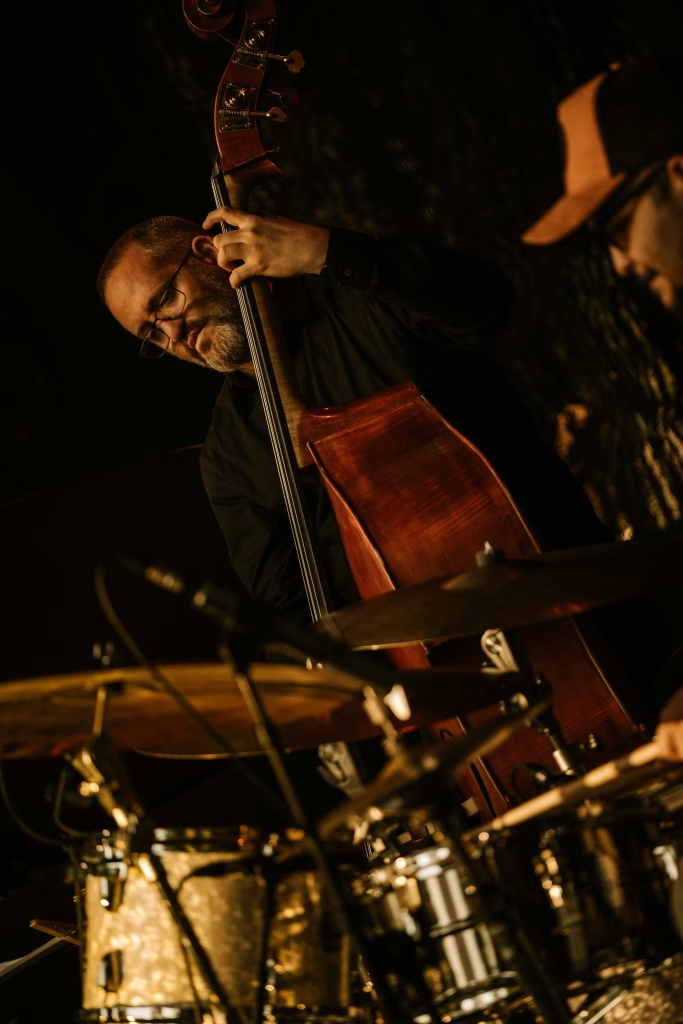
Aldana recorded Filin with legendary Cuban pianist Gonzalo Rubalcaba, but for the touring band she appeared in Ljubljana alongside Pablo Held, Robert Landfermann, and Kush Abadey, who also played drums on the recording. During the hour-long set, which opened the park stage programme beside Cankarjev dom on the festival’s third day, the quartet performed music not only from Filin, but also from Aldana’s previous album Echoes of the Inner Prophet and included one composition by Held.

A tribute to Sonny Rollins and the power of space
While the audience was still gathering and the evening sun slowly began to set, Aldana dedicated the performance to the late Sonny Rollins, who passed away on May 25, 2026. The quartet opened with her ballad “Beyond the Blue.” From the first notes, Aldana’s full tenor sound immediately filled the space. She first exchanged phrases with Held before the rhythm section joined with a relaxed and unobtrusive groove.
Rather than filling every moment, Aldana allowed space between her phrases, giving each note weight and direction. Her solo showed complete control over dynamics and timing, while Held responded with flowing lines and rhythmic ideas that gradually drew the rhythm section further into the conversation.
The open-air setting, however, was not ideal for this kind of intimate performance. With relatively few chairs in front of the stage, much of the audience remained standing, talking, and enjoying drinks while the concert unfolded. Still, it did not appear to distract the musicians, who continued with Held’s jazz waltz “The Outriders.”
After Abadey’s open drum introduction established the groove, the piece developed through collective interplay. Aldana combined spacious phrases with fast lines and rhythmic motifs, constantly shaping her solo as a dialogue with the band. Held followed with a piano solo full of rhythmic ideas before Landfermann and Abadey created an understated but constantly shifting foundation beneath the music.
The emotional language of Filin
Aldana then took a moment to introduce her latest project and explain how the Cuban filin movement of the late 1940s through the early 1960s inspired her to record an album centred around ballads. The word itself derives from “feeling,” and the movement created a dialogue between traditional Cuban trova, bolero, and jazz, helping redefine Cuban musical identity.
She explained that many of the songs were recommended to her by Gonzalo Rubalcaba, who also arranged “Dime Si Eres Tú,” a ballad by César Portillo de la Luz, one of the pioneers of filin. Aldana admitted that it is difficult to deliver the emotional message of a song without words, yet her sound and phrasing naturally carried the feeling of a love song.
The melody moved gently between saxophone and piano, while her long, singing notes floated above the band’s restrained accompaniment. The quartet created space around the melody, allowing the emotion of the composition to emerge without forcing it.


From lyrical ballads to rhythmic interplay
As a contrast to the intimacy of the ballads, the quartet moved into Aldana’s own composition “Los Ojos de Chile (Echoes of Chile).” Another impressionistic dialogue between saxophone and piano opened the piece before the musicians moved into a busier and faster 6/8 groove.
The change revealed another side of the quartet’s interaction. They shaped the music through dynamics and rhythmic tension, creating movement through communication rather than intensity alone. Held began his solo with a rhythmic pulse built around a single note, gradually expanding it through increasingly complex rhythmic ideas that lifted the energy of the performance.

A reflective conclusion with La Sentencia
Aldana closed her Ljubljana Jazz Festival appearance with another composition from Filin, Salvador Levy’s “La Sentencia.” The beautiful ballad provided a fitting conclusion, ending the set with the same reflective atmosphere that characterised much of the performance before Patricia Brennan Septet took the stage.
The only thing missing was a quieter listening environment. Music built on subtle dynamics, lyrical phrasing, and patient interplay naturally invites concentrated attention, something difficult to achieve in a festival park setting where concerts often become part of a broader social gathering. Fortunately, audiences in Ljubljana will soon have another opportunity to hear Aldana in a more intimate setting, as she returns on November 2 to perform alongside Joe Lovano in a concert celebrating John Coltrane’s 100th birthday.
Still, Melissa Aldana and her quartet demonstrated why she is regarded as one of today’s leading tenor saxophonists. Her performance showed a deep connection to jazz tradition while bringing her own voice through both her compositions and her interpretations of Cuban songs from the filin repertoire.